
What does Yield mean?
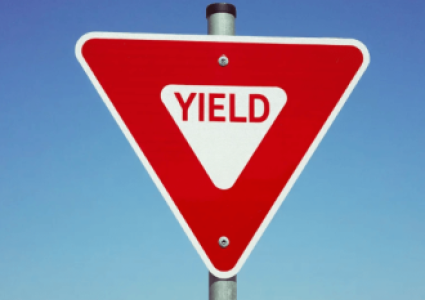
The "Yield" sign is one of the key regulatory traffic signs in the USA, designed to ensure safety and orderly movement at intersections and road merges. This sign is an inverted triangle with a red border and a white background, usually with the word "YIELD" written in black. Its main function is to inform drivers of the need to yield to other road users, including vehicles, pedestrians, and cyclists, who have the right of way in that section.
Unlike the "Stop" sign, which requires a complete stop regardless of the presence of other vehicles, the "Yield" sign obliges the driver to slow down and, if necessary, stop to let traffic or pedestrians with the right of way pass. If the way is clear, the driver can continue moving without stopping. It is important to understand that "yield" means giving priority to other road users, not just slowing down or making a "smooth stop" without objective necessity.
The "Yield" sign is widely used not only on urban and rural roads but also in work zones where the movement of special equipment and pedestrians requires special attention and coordination.
Visual Characteristics and Standards of the Sign
In the USA, the "Yield" sign has a clearly defined appearance that is easily recognizable and standardized:
| Characteristic | Description |
| Shape | Inverted equilateral triangle with the point downwards |
| Color Scheme | Red border and white background |
| Text | Black inscription "YIELD" (sometimes "GIVE WAY" in other countries) |
| Sizes | Standard sizes vary, but usually about 60 cm per side of the triangle |
| Installation Location | At intersections, road merges, entrances to roundabouts, and places with heavy traffic |
Main Functions and Objectives of Application
The "Yield" sign performs several important functions aimed at ensuring safety and efficiency of traffic:
Regulating Priority at Intersections and Merges
The sign informs drivers of the need to yield to vehicles moving on the main road or already on the roundabout. This prevents conflicts and accidents, especially in places without traffic lights.
Ensuring Smooth Traffic Flow
Unlike the "Stop" sign, which requires a complete stop, the "Yield" sign allows the driver to continue moving without stopping if the road is clear. This helps reduce congestion and more efficient use of road space.
Enhancing Safety for Pedestrians and Cyclists
Drivers must yield not only to other vehicles but also to pedestrians and cyclists, reducing the risk of accidents and injuries.
Reducing the Number of Accidents at Intersections
Due to the clear indication of priority, the sign helps avoid collisions, especially in conditions of limited visibility or complex traffic situations.
Differences Between the "Yield" Sign and the "Stop" Sign
Although both signs are regulatory and related to priority control, there are important differences between them that affect driver behavior:
| Characteristic | "Yield" Sign | "Stop" Sign |
| Obligation to Stop | Not necessary to stop if the road is clear | Complete stop required regardless of the situation |
| Purpose | Yield priority, slow down or stop if necessary | Completely stop and yield the way |
| Application Location | At intersections without traffic lights, merges, entrances to roundabouts | At intersections with limited visibility or high accident rates |
| Driver Behavior | Assess the situation, yield, continue moving | Stop, ensure safety, then continue |
Thus, the "Yield" sign is more flexible and aimed at maintaining smooth traffic, while the "Stop" sign is a strict requirement to stop for safety reasons.
Driver Responsibilities
In the USA, the "Yield" sign is mandatory under state laws. Failure to comply with the sign's requirements can result in fines, penalty points, and even liability for accidents. Drivers are obligated to:
- Reduce speed when approaching the sign
- Assess the traffic situation and yield to other road users
- Stop if necessary to ensure safety
- Continue moving only if there are no obstructions
It is important to note that ignoring the "Yield" sign is considered a traffic violation and can lead to serious consequences, including accidents and injuries.
Application of the Sign in Various Situations
The "Yield" sign is installed in various conditions, and its application is adapted to the specifics of a particular traffic situation:
| Situation | Features of the "Yield" Sign Application |
| Entrance to a Highway | The driver must yield to vehicles moving on the highway, reducing speed and stopping if necessary |
| Roundabouts | Vehicles entering the roundabout must yield to those already on the roundabout (usually from the left side) |
| Intersections Without Traffic Lights | The sign helps determine the order of passage, reducing the risk of conflicts and accidents |
| Work Zones and Industrial Areas | Used to regulate the movement of special equipment and pedestrians, increasing safety on the premises |
How to Correctly Understand and React to the "Yield" Sign
When you approach a "Yield" sign, your task is not just to slow down but to conduct a thorough analysis of the traffic situation. This is not just a sign for you to "slow down a bit and keep going," but a real test of attentiveness and decision-making ability. Imagine that you are the conductor of an orchestra, and the streams of cars are musicians, and your task is to prevent them from playing out of tune.
The driver needs to assess:
- Are there vehicles or pedestrians to whom you need to yield?
- The speed and distance of approaching vehicles.
- The possibility of continuing safely without creating an accident situation.
If the road is clear, you can continue moving without stopping, but be ready to stop at any moment if the situation changes. If visibility is limited (for example, due to buildings, bushes, or parked cars), you should significantly reduce speed and be prepared for a complete stop.
Many mistakenly believe that the "Yield" sign is almost like a stop sign and that you must stop. In fact, this is not the case. The rules state: the driver must slow down and be prepared to stop if necessary. If the road is clear, you can pass without stopping.
However, there are situations when stopping is mandatory:
- If approaching vehicles do not allow you to continue safely.
- If there are pedestrians crossing the road.
- If visibility is limited and there is no certainty about the safety of the maneuver.
At other times, it is enough to smoothly reduce speed, carefully inspect the intersection, and continue moving if there are no obstructions. Thus, the "Yield" sign is not a command for a complete stop but a call for conscious slowing down and situation control.
Behavior Features at Roundabouts and Exits from the Main Road
If you think that the "Yield" sign is only for ordinary intersections, you are somewhat mistaken. Most often, this sign is found at roundabouts and exits from the main road to a secondary road (so-called slip lanes).
At roundabouts, a simple rule applies: yield to vehicles already in the circle. This means that you must slow down, assess the flow, and let everyone who is moving in the circle pass before entering it.
At exits from the main road, the "Yield" sign warns of the need to yield to vehicles moving on the main road to avoid accident situations when merging flows.
| Sign Location | Behavior Recommendations |
| Roundabout | Yield to vehicles in the circle |
| Exit from the Main Road | Slow down and yield to vehicles on the main road |
| Quiet Residential Intersections | Be prepared to yield to other road users |
Fines
Correctly understanding the requirements of the "Yield" sign is a matter of safety and legal responsibility. Non-compliance with the rules can lead to serious accidents and fines.
The table below reflects the main consequences of violating the yielding rules:
| Consequence of Violation | Description |
| Fines | Monetary penalties depending on the state |
| Penalty Points | Accumulation of points affecting driving licenses |
| Increase in Insurance Premiums | Rise in insurance costs after a violation |
| Risk of Accidents | Increased probability of accidents with injuries and damages |
Violating the requirements of the "Yield" sign entails administrative fines, and in the case of creating an accident situation, civil and criminal liability. Drivers who ignore the sign are often found at fault in accidents, which affects insurance payments and can lead to lawsuits.
Features of Application in Different States
Although the "Yield" sign is standardized at the federal level (red triangle with a white background and the inscription YIELD), the rules for its application and driver requirements may vary in different states. For example, in some states, the driver must come to a complete stop before the sign if visibility is limited or the traffic flow is intense; in others, stopping is required only when necessary to yield.
There are also peculiarities when entering highways from acceleration lanes: in a number of states, a complete stop is required before merging to yield to the main flow, while in others, it is enough to smoothly reduce speed and assess the situation.
| State | Driver Requirement at the "Yield" Sign | Application Features |
| California | Reduce speed, stop if necessary | Strict yielding rules on highways |
| Texas | Yield, stop mandatory for pedestrians | Special attention to pedestrians and emergency services |
| Oklahoma | Complete stop with poor visibility | Historical place of the sign's appearance |
| New York | Smooth speed reduction, stop as needed | Emphasis on safety in urban conditions |
Thus, the "Yield" sign is not just a formality but an important tool for ensuring safety and order on the roads of the USA.